A statewide schedule did not arrive all at once. The record traces changes in shared parental authority, enforceable time, and the starting point courts use when parents disagree.
Two questions run through this history.
How much should the law specify? And how much should it leave to an individual court? Fathers’ organizations, family-law organizations, legislators, and other participants have sometimes worked together and sometimes disagreed over those choices.
From individual orders to a statutory starting point
The milestones below concern different things: legal authority, definite schedules, and the amount or timing of possession. A change in one does not necessarily change the others.
1979
Joint authority
Shared authority by agreement
Parents could agree to joint managing conservatorship, subject to court approval.
Fathers’ groups have a documented place in the history
In his retrospective account, John J. Sampson describes systematic lobbying by volunteer fathers’ groups beginning in 1977. He credits Texas Fathers for Equal Rights with promoting the 1979 joint-custody amendment. He also describes cooperation with the State Bar Family Law Section, including its contribution to more equal treatment of parents. Read pp. 102–103 of the published article.
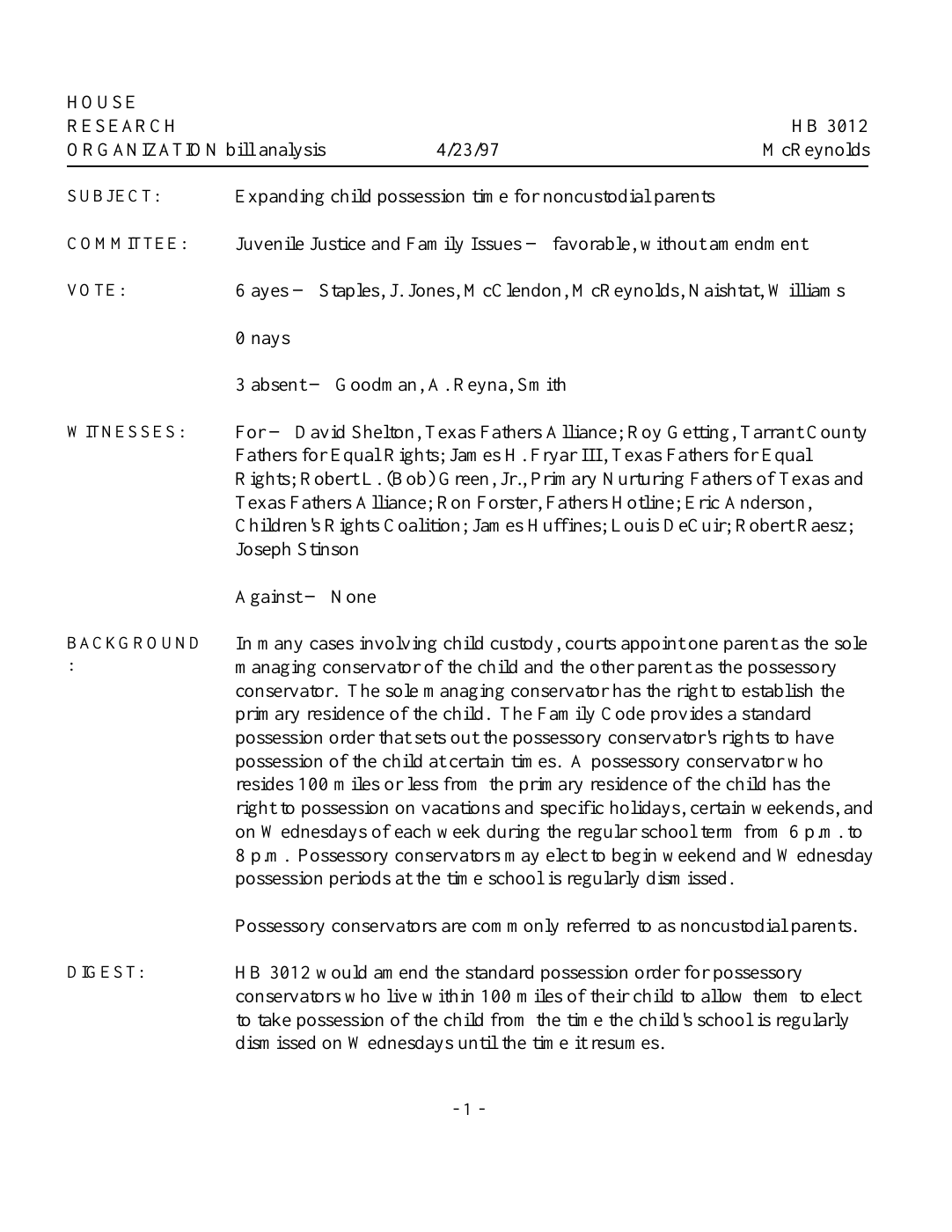
The House Research Organization’s analysis of HB 3012 identifies witnesses for the bill from Texas Fathers Alliance, Tarrant County Fathers for Equal Rights, Texas Fathers for Equal Rights, Primary Nurturing Fathers of Texas, Fathers Hotline, and the Children’s Rights Coalition.
The proposed change was practical: extend the midweek period through the next school morning. The analysis attributes to supporters the argument that an overnight would allow more participation in homework and school routines. It also summarizes objections about school-week disruption.
A useful distinction in the document
The witness list names no witnesses against the bill, although page 2 describes opponents’ arguments. Those arguments cannot be attributed to a particular organization from this document alone.
Supporting more time and supporting an equal-time default are different positions
The 2019 hearing makes the distinction visible. Laura Alter supported all three bills below. Texas Family Law Foundation participants supported HB 1807 and opposed HB 2157 and HB 3414. Benjamin Beveridge was listed “On” HB 1807 and “For” the other two, affiliated with The Fathers’ Rights Movement. Official April 24, 2019 witness list.
TFLF = Texas Family Law Foundation. Bill descriptions are summaries; inspect the proposals and procedural histories →. The position labels summarize participants affiliated with the Foundation, not every Texas family-law attorney.
Who is named in the 2019 record?
Bill Morris testified for HB 1807. Steve Bresnen, Craig Haston, and Bill Morris testified against HB 2157 and HB 3414. Amy Bresnen registered against those two bills. Registration and testimony are separately identified in the official list.
The April 26 witness list records TFLF-affiliated Leigh De la Reza and David Kazen against HB 803. It records De la Reza for HB 3203. Amy and Steve Bresnen registered against HB 803 and for HB 3203. Read the official 2021 witness list.
HB 803 · Equal-parenting proposal
Heard, but not enacted
The research record tracks its public hearing and the bill being left pending.
These episodes document support for some possession expansions alongside opposition to equal-parenting models. They do not establish that the Foundation opposed all reform—or that its opposition caused a particular bill to fail.
Publication context: this history is hosted by Beveridge Law Firm. Benjamin Beveridge is also a participant named in the legislative record.
04 · What changed in practice
Shared legal authority and the physical calendar remain distinct
Legal authority
Joint managing conservatorship
Allocates parental rights and duties. It does not by itself require equal or nearly equal physical possession.
Physical time
Possession and access
Determines the schedule. Chapter 153 supplies a standard order, expanded times in qualifying cases, and rules for agreements and departures.
Section 153.317 provided alternative beginning and ending times that a conservator could elect, subject to statutory conditions.
After HB 3203
Expanded times generally apply within 50 miles
Section 153.3171 directs their use in qualifying cases, unless a parent declines or another statutory exception applies. Safety, feasibility, and best-interest provisions remain.
Compare the enacted language. This diagram describes legal rules; it is not an annual time-percentage calculation or an individual possession calendar.
05 · Understanding the disagreement
The recurring dispute concerns the starting rule and its exceptions
The argument records collect positions about parental involvement, predictable outcomes, judicial discretion, feasibility, family violence, and child support. They document what participants argued; they do not independently establish the effects of a custody arrangement on children.
Arguments for a stronger equal-time default
Advocates describe a clearer starting point as a way to support involvement by both parents and reduce the burden of seeking a different schedule.
Other participants emphasize differences in safety, distance, work, school, and family circumstances when objecting to particular equal-time proposals.
Different bill designs answer those concerns differently. A proposal adding an optional schedule is not the same as one creating a rebuttable presumption. Read the proposed text, its exceptions, and the actual legislative outcome together.
A position is not proof of causation. An organization’s statement is not proof of every member’s views. Earlier historical accounts and modern witness lists have different evidentiary strengths. This collection does not establish that any one group created—or prevented—the entire present Family Code.
Documents, advocacy and reporting
Read the materials bill by bill
One row per bill, with supporting material, opposition or critiques, news coverage, and official records. This collection contains 36 distinct sources across 10 bills; some sources address more than one bill. Updated October 6, 2026.
Newly added: the HB 453 legislative packet and signed hearing request, the HB 3414 election handout, and Laura Alter’s HB 803 analysis. Six archived PDFs, including the original TFLF opposition memo and 2017 session report, can be opened directly below.
Position labels describe the source’s stance. Laura Alter’s analysis supports reform and proposes amendments; it is listed with critiques for that reason. News coverage is not an outlet endorsement, and a witness list can record both sides. HB 1807 and SB 1936 are related possession proposals included for context.
Supports HB 453 and discusses opponents’ arguments, with a clip described as testimony on the 2015 bill.
Public article read. Embedded clip was not watched; article’s characterizations and financial-motive allegations need attribution and comparison with the full hearing.
Records both sidesHB 2363 hearing witness listTexas House • Juvenile Justice and Family Issues Committee · 2015-04-15WebsiteSource notes
Lists supporters including fathers’ rights and Fix Family Courts participants; Lynn Kamin is listed against for the Family Law Foundation.
Official record read. Shows stated positions and representation, not the content or persuasive effect of testimony. Testifying and registering-only categories must remain distinct.
Locator: HB 2363 section
Source S07
HB 4532017
Original TFLF report: p. 2. Original TFLF opposition memo: both pages. Chron is a guest opinion column. The added packet is authored by Benjamin Beveridge; the signed hearing request is dated February 21, 2017.
Supports HB 453 and discusses opponents’ arguments, with a clip described as testimony on the 2015 bill.
Public article read. Embedded clip was not watched; article’s characterizations and financial-motive allegations need attribution and comparison with the full hearing.
Advocate’s account of the bill’s withdrawal and a committee statement attributed to Harold Dutton.
Public article read. Embedded clip not watched. Claims about threats and why the bill failed require attribution; compare the unedited record and TFLF’s own report.
Guest column supports shared-parenting presumptions and discusses HB 453’s failure and opposition from the family-law bar.
Public opinion column read. This is an advocate’s commentary carried by a news outlet; polling, research and motive claims were not independently audited.
Advocacy packet supporting HB 453, with arguments, proposed-bill summaries, references and research appendices.
Version 1.0 credits Benjamin Beveridge. This is a historical advocacy publication; its empirical, constitutional and causal claims are not independently established by inclusion here.
Locator: PDF pp. 1–2, 6–7, 19–20; references and appendices follow
Lists HB 453 among bills opposed by TFLF; discusses its opposition and the bill’s failure. Also identifies bills TFLF supported.
Original seven-page PDF recovered from existing Drive archive and read. The report is the authors’ account, not independent proof that TFLF caused a bill’s failure. Duplicate copy excluded.
Direct request to legislators to oppose HB 453. Arguments concern best interests, existing possession options, young children, child support and renewed litigation.
Original two-page scanned PDF visually reviewed. Possession-percentage claims are advocacy assertions; their counting method was not independently checked.
Documents TFLF opposition to HB 2157 and HB 3414 and support for HB 1807. Lists Benjamin Beveridge and other advocates for the equal-parenting bills.
Official record read. Use the bill-specific section. An “On” registration is not automatically opposition; registering without testimony is not oral testimony.
Locator: Separate sections for each bill
Source S08
HB 21572019
S03 reproduces an excerpt attributed to TFLF’s 2019 report. Complete original report not recovered. S20 has a year error; use 2019.
Campaign hub for successive proposals, criticism of opposition, and embedded video leads.
Public page read; videos not reviewed. The page misplaces HB 2157 and HB 3414 under 2007; both are 2019 bills. Useful for leads, not an authoritative chronology.
Locator: Bill list and video embeds
Source S20
For; quotes oppositionFamily attorneys support HB 803TexasGOPVote • David Bellow; letter by Justin M. Jackson · 2021-02-23WebsiteSource notes
Publishes an attorney’s pro-HB 803 letter and an excerpt attributed to TFLF’s 2019 report opposing HB 2157. Challenges the report’s survey and comparison to standard possession.
Full page read. Original complete 2019 TFLF report and survey not recovered. The quoted 72% refers to surveyed lawyers who had handled later modifications, not a failure rate for all equal-time families.
Documents TFLF opposition to HB 2157 and HB 3414 and support for HB 1807. Lists Benjamin Beveridge and other advocates for the equal-parenting bills.
Official record read. Use the bill-specific section. An “On” registration is not automatically opposition; registering without testimony is not oral testimony.
Provides the official sequence of committee action and movement to Calendars for checking campaign accounts.
Official history retrieved. Procedural context; not an endorsement or opposition document.
Locator: Actions / history
Source S31
HB 34142019
TFLF opposition is recorded in the witness list. S20 misplaces this bill under 2007; use 2019. The added handout describes an elective schedule and retains judicial discretion; its author is not identified.
Campaign hub for successive proposals, criticism of opposition, and embedded video leads.
Public page read; videos not reviewed. The page misplaces HB 2157 and HB 3414 under 2007; both are 2019 bills. Useful for leads, not an authoritative chronology.
Locator: Bill list and video embeds
Source S20
ForAdded from archiveHB 3414: Equal Parenting Time ElectionArchived advocacy handout · author not identified · 2019 session; undatedPDF · 1 page · Archived copySource notes
Explains an elective equal-possession schedule subject to a judge’s best-interest determination; distinguishes the election from a mandatory equal-time rule.
Footer identifies Texas 86R, HB 3414 and Rep. Sanford, but does not identify the author. Schedule percentages and claimed effects are the handout’s assertions.
Documents TFLF opposition to HB 2157 and HB 3414 and support for HB 1807. Lists Benjamin Beveridge and other advocates for the equal-parenting bills.
Official record read. Use the bill-specific section. An “On” registration is not automatically opposition; registering without testimony is not oral testimony.
Locator: Separate sections for each bill
Source S08
HB 8032021
Cowles Thompson and Texas Lawyer are attorney commentary. Official witness list records positions. Bill was not enacted. Laura Alter supports reform while recommending changes to HB 803; see her concluding slides.
For; quotes oppositionFamily attorneys support HB 803TexasGOPVote • David Bellow; letter by Justin M. Jackson · 2021-02-23WebsiteSource notes
Publishes an attorney’s pro-HB 803 letter and an excerpt attributed to TFLF’s 2019 report opposing HB 2157. Challenges the report’s survey and comparison to standard possession.
Full page read. Original complete 2019 TFLF report and survey not recovered. The quoted 72% refers to surveyed lawyers who had handled later modifications, not a failure rate for all equal-time families.
Describes turnout, testimony and a demand for a committee vote.
Full public page read. Attendance estimate is not independently counted. Characterization of all opponents as financially interested should not replace the official witness list.
Campaign hub for successive proposals, criticism of opposition, and embedded video leads.
Public page read; videos not reviewed. The page misplaces HB 2157 and HB 3414 under 2007; both are 2019 bills. Useful for leads, not an authoritative chronology.
Argues that a presumption may poorly fit high-conflict families, special needs, safety concerns, distance and very young children; cites a TFLF survey.
Full public HTML retrieved and read. Commentary, not an empirical evaluation. Footnote links to an expired signed PDF of a TFLF report; that original report was not recovered through this link.
Locator: Article and footnotes 4–5
Source S04
Against / concernsChildren at RiskTexas Lawyer • Justin Sisemore · 2021-07/08PDFSource notes
Warns that HB 803 could increase disputes where joint decision-making agreements lack tie-breakers, especially with court backlogs.
Magazine PDF downloaded; relevant article text read. Attorney-authored opinion. Distinguish allocation of decision-making authority from division of possession time. Article describes the bill as pending when submitted.
Locator: Printed p. 28; continuation p. 30
Source S15
For reform; recommends amendmentsAdded from archiveHB 803 analysis and recommended updatesLaura Alter · 2021-03-01PDF · 37 pages · Archived copySource notes
Supports maximizing parenting time while criticizing HB 803’s treatment of the existing presumption, its definition of equal time and its lack of sample schedules.
Cover date is March 1, 2021 despite a 2020 date in the archived filename. Read the recommendations on PDF pp. 31–36; this is not an unqualified endorsement of HB 803. Calendar estimates are illustrative and not independently audited.
Locator: PDF pp. 1, 31–36; calendar assumptions p. 37
Reports supporters’ efforts to secure a hearing, including interviews with Sarah Jae Johnston and Derek Berry.
Public article read; embedded video not separately reviewed. Statements about typical parenting percentages and policy effects remain attributed to their speakers.
Contemporaneous reporting on the stalled bill, supporters’ campaign and concerns about children moving between households.
Public article read; embedded video not separately reviewed. Reported accusations about opponents’ motives are claims, not established findings.
Locator: Article and embedded report
Source S12
Records both sidesHB 803 hearing witness listTexas House • Juvenile Justice and Family Issues Committee · 2021-04-26WebsiteSource notes
Records advocates for HB 803 and opposition including TFLF representatives and Texas Council on Family Violence. Amy and Steve Bresnen registered against without testifying.
Official record read. Establishes declared hearing positions; it does not itself establish motives or what every witness said. “On” is a separate classification.
Explains expanded standard possession for parents living within 50 miles and describes SB 1936 as a response to calls for more parenting time.
Full page read. Describes an incremental possession reform, not enactment of HB 803 or a universal equal-time presumption. Its percentage estimate is attributed, not independently recalculated.
Three-page support handout frames changes to best-interest factors, parenting time and child-support calculations, with polling material.
Original public PDF read. Polling and comparative-policy claims are presented by proponents; their underlying datasets and methodology were not separately audited.
Cites bipartisan coauthorship and urges legislative action; criticizes opposition.
Full public page read. Coauthor count is the author’s count as of publication and was not independently recounted. Campaign commentary, not neutral reporting.
Campaign hub for successive proposals, criticism of opposition, and embedded video leads.
Public page read; videos not reviewed. The page misplaces HB 2157 and HB 3414 under 2007; both are 2019 bills. Useful for leads, not an authoritative chronology.
Reproduces selected objections attributed to TFLF’s March 13 email and rebuts them. Covers parenting time, support calculations, distance and relocation.
Full public page read. Primary evidence of NPO’s position; TFLF excerpts are mediated through an opposing advocate. Original complete TFLF email not independently obtained.
Campaign hub for successive proposals, criticism of opposition, and embedded video leads.
Public page read; videos not reviewed. The page misplaces HB 2157 and HB 3414 under 2007; both are 2019 bills. Useful for leads, not an authoritative chronology.
Locator: Bill list and video embeds
Source S20
No separate item in this collection.
No separate item in this collection.
SB 8492025
The campaign materials urged a hearing. Official history shows no enactment. No original TFLF opposition document recovered.
Records referral to Senate State Affairs on February 13, 2025, with no later passage action shown.
Official history read. This bill was not enacted; secondary pages describing it as an enacted 2025 or 2026 equal-parenting law conflict with the record.
Locator: Actions / history
Source S32
The table preserves historical arguments and identifies their authors and limits. Inclusion does not independently verify a source’s statistics, legal interpretation, or account of why a bill failed. The complete 2019 TFLF report and 2023 email have not been recovered; linked excerpts are identified as reproductions.
The supporting archive
Examine the evidence behind the history
414 research records across five collections, with source links, attribution, and research limitations. These are records—not 414 distinct bills or independent findings. Choose a question below to investigate the details.
Statutory changes
19 of 19 records
Pre-1973P2-001High
Pre-codification Texas custody law
No single enactment marks this era. It is the baseline from which the 1973 Family Code and later possession statutes developed.
Before
Texas courts used the language of custody. Split custody was disfavored, and one parent ordinarily received custody while the other parent had whatever visitation the decree provided.
After
The 1973 Family Code would replace the older custody terminology with managing and possessory conservatorship, but statewide parenting-time schedules still did not exist.
Full record and source links
ID
P2-001
era
Era 1 - Broad discretion and the one-primary-parent model
year
Pre-1973
session
Pre-Family Code
bill act
Pre-codification Texas custody law
sections
Common-law custody / divorce statutes
before
Texas courts used the language of custody. Split custody was disfavored, and one parent ordinarily received custody while the other parent had whatever visitation the decree provided.
change
No single enactment marks this era. It is the baseline from which the 1973 Family Code and later possession statutes developed.
after
The 1973 Family Code would replace the older custody terminology with managing and possessory conservatorship, but statewide parenting-time schedules still did not exist.
significance
Establishes the starting point: parenting time was not governed by a statewide standardized possession schedule.
Use as historical baseline; actor responsibility belongs in Phase 4.
1973P2-002High
Acts 1973, 63rd Leg., R.S., ch. 543 - Original Texas Family Code
The new Family Code recast the relationship in terms of managing and possessory conservators. Best interest remained the primary consideration. The managing conservator generally held the principal residential and decision-making role; the possessory conservator held possession/access rights set by the court.
Before
Texas divorce law spoke principally in terms of custody. One parent commonly had custody and the other parent had visitation.
After
Texas had a statutory conservatorship framework, but not a statewide SPO. Courts still had substantial discretion over how much time the possessory conservator actually received.
Full record and source links
ID
P2-002
era
Era 1 - Broad discretion and the one-primary-parent model
year
1973
session
63rd Regular
bill act
Acts 1973, 63rd Leg., R.S., ch. 543 - Original Texas Family Code
sections
Former Title 2, parent-child relationship
before
Texas divorce law spoke principally in terms of custody. One parent commonly had custody and the other parent had visitation.
change
The new Family Code recast the relationship in terms of managing and possessory conservators. Best interest remained the primary consideration. The managing conservator generally held the principal residential and decision-making role; the possessory conservator held possession/access rights set by the court.
after
Texas had a statutory conservatorship framework, but not a statewide SPO. Courts still had substantial discretion over how much time the possessory conservator actually received.
significance
Creates the legal architecture that later SPO statutes would regulate.
The Legislature authorized parents, by written agreement approved by the court, to be appointed joint managing conservators.
Before
The statutory structure generally contemplated a single managing conservator and a possessory conservator.
After
Joint managing conservatorship became legally available, but it depended on agreement; a court still could not simply impose JMC over objection under the pre-1987 framework.
Full record and source links
ID
P2-003
era
Era 1 - Broad discretion and the one-primary-parent model
The statutory structure generally contemplated a single managing conservator and a possessory conservator.
change
The Legislature authorized parents, by written agreement approved by the court, to be appointed joint managing conservators.
after
Joint managing conservatorship became legally available, but it depended on agreement; a court still could not simply impose JMC over objection under the pre-1987 framework.
significance
First major statutory step toward shared parental authority, but not yet a change in the amount of parenting time.
Original bill number remains to be matched to the session-law chapter.
1983P2-004High on the statutory direction; moderate on exact act/bill mapping
1983 amendments to former Family Code §14.03
Texas required possession/access terms to be specific and expressly stated unless good cause existed, and the Legislature moved toward local schedules, guidelines, or formulas for possession/access.
Before
Orders could use vague concepts such as reasonable visitation, leaving parents without a precise statewide schedule.
After
The law increasingly required concrete terms, but there was still no uniform statewide schedule. Local judicial practices could differ substantially.
Full record and source links
ID
P2-004
era
Era 2 - Specificity and local-guideline experiment
year
1983
session
68th Regular
bill act
1983 amendments to former Family Code §14.03
sections
Former §14.03 - possession/access orders
before
Orders could use vague concepts such as reasonable visitation, leaving parents without a precise statewide schedule.
change
Texas required possession/access terms to be specific and expressly stated unless good cause existed, and the Legislature moved toward local schedules, guidelines, or formulas for possession/access.
after
The law increasingly required concrete terms, but there was still no uniform statewide schedule. Local judicial practices could differ substantially.
significance
This is the bridge between vague visitation and the later statewide SPO.
confidence
High on the statutory direction; moderate on exact act/bill mapping
primary name
Historical Texas Family Code (1984), Texas State Law Library
The Legislature declared a policy favoring frequent and continuing contact with fit parents and encouraging parents to share rights and duties. Courts could appoint joint managing conservators even without a prior written agreement.
Before
JMC generally depended on parental agreement. Texas did not yet have the modern policy language emphasizing continuing contact and shared parental responsibilities.
After
Texas law affirmatively encouraged shared parental authority, but JMC still did not mean equal or nearly equal physical possession. A primary residential arrangement could remain.
Full record and source links
ID
P2-005
era
Era 3 - Shared-parenting policy without an equal-time right
JMC generally depended on parental agreement. Texas did not yet have the modern policy language emphasizing continuing contact and shared parental responsibilities.
change
The Legislature declared a policy favoring frequent and continuing contact with fit parents and encouraging parents to share rights and duties. Courts could appoint joint managing conservators even without a prior written agreement.
after
Texas law affirmatively encouraged shared parental authority, but JMC still did not mean equal or nearly equal physical possession. A primary residential arrangement could remain.
significance
Separates two concepts that remain distinct today: joint legal conservatorship and the quantity of parenting time.
The Legislature replaced the local-guideline approach with statewide possession guidelines. The standard order established recurring weekends, a midweek period, holidays and summer possession. The statutory framework created a rebuttable presumption that the standard order provided reasonable minimum possession and was in the child's best interest. Parties could still agree to different times; courts could deviate when the standard was unworkable or inappropriate.
Before
Texas had increasingly specific orders and local guideline experiments, but no single statewide schedule guaranteed the non-primary parent a uniform baseline.
After
Texas now had a statewide default schedule and a statutory minimum/best-interest presumption. The non-primary parent no longer depended solely on a judge's individualized concept of reasonable visitation.
Former §§14.032-.034, including §14.033 and §14.034
before
Texas had increasingly specific orders and local guideline experiments, but no single statewide schedule guaranteed the non-primary parent a uniform baseline.
change
The Legislature replaced the local-guideline approach with statewide possession guidelines. The standard order established recurring weekends, a midweek period, holidays and summer possession. The statutory framework created a rebuttable presumption that the standard order provided reasonable minimum possession and was in the child's best interest. Parties could still agree to different times; courts could deviate when the standard was unworkable or inappropriate.
after
Texas now had a statewide default schedule and a statutory minimum/best-interest presumption. The non-primary parent no longer depended solely on a judge's individualized concept of reasonable visitation.
significance
Foundational milestone. This is the true origin of the modern SPO architecture and the minimum/best-interest presumption.
Critical correction: the minimum/best-interest presumption was already part of the 1989 regime; it was not first created by the 1995 recodification.
1989-1993P2-007High
Early alternative beginning/ending times within the SPO framework
The early SPO framework also allowed alternative beginning and ending times under statutory conditions, including school-dismissal pickup in place of a fixed evening start. By 1993, appellate decisions were already applying these alternative-time provisions.
Before
The new SPO supplied a statewide baseline schedule.
After
Texas had both a basic standard schedule and a statutory mechanism for longer/alternative start and end times. The concept later known as expanded standard possession therefore predates the 1995 recodification.
Full record and source links
ID
P2-007
era
Era 4 - Statewide SPO and presumptive minimum
year
1989-1993
session
71st-73rd Regular
bill act
Early alternative beginning/ending times within the SPO framework
sections
Former §14.033(i) - Alternative Possession Times
before
The new SPO supplied a statewide baseline schedule.
change
The early SPO framework also allowed alternative beginning and ending times under statutory conditions, including school-dismissal pickup in place of a fixed evening start. By 1993, appellate decisions were already applying these alternative-time provisions.
after
Texas had both a basic standard schedule and a statutory mechanism for longer/alternative start and end times. The concept later known as expanded standard possession therefore predates the 1995 recodification.
significance
Corrects a common historical misconception: expanded/alternative times were not invented in 2013 or 2021.
Exact first enactment date of every alternative-time clause can be further refined from session laws.
1993P2-008Moderate-high; exact line-by-line change still needs archival side-by-side
HB 1630, Acts 1993, 73rd Leg., R.S., ch. 766
HB 1630 modified the rights, privileges, duties and powers of conservators and affected the election/alternative-time framework. Later cases applying the pre-1995 law describe a possessory conservator's statutory election of longer beginning/ending times.
Before
Alternative-time provisions already existed within the SPO.
After
The election mechanism for alternative possession times was more developed heading into the 1995 recodification.
Full record and source links
ID
P2-008
era
Era 5 - Election mechanics, recodification, and JMC presumption
year
1993
session
73rd Regular
bill act
HB 1630, Acts 1993, 73rd Leg., R.S., ch. 766
sections
Former Title 2 conservatorship and possession provisions
before
Alternative-time provisions already existed within the SPO.
change
HB 1630 modified the rights, privileges, duties and powers of conservators and affected the election/alternative-time framework. Later cases applying the pre-1995 law describe a possessory conservator's statutory election of longer beginning/ending times.
after
The election mechanism for alternative possession times was more developed heading into the 1995 recodification.
significance
Part of the evolution from a simple basic schedule toward a recognizable expanded-standard system.
confidence
Moderate-high; exact line-by-line change still needs archival side-by-side
The Legislature recodified the Family Code into the modern Chapter 153 structure. The SPO presumption appears today in §153.252; mutual agreement, deviation, findings and specified terms were reorganized into modern sections.
Before
The operative provisions were scattered through former Title 2, including the 1989 SPO and its presumptions.
After
The same basic statewide SPO architecture continued in a reorganized code. The recodification should not be mistaken for the substantive birth of the SPO.
Full record and source links
ID
P2-009
era
Era 5 - Election mechanics, recodification, and JMC presumption
Modern Chapter 153, including §§153.251-.258 and Subchapter F
before
The operative provisions were scattered through former Title 2, including the 1989 SPO and its presumptions.
change
The Legislature recodified the Family Code into the modern Chapter 153 structure. The SPO presumption appears today in §153.252; mutual agreement, deviation, findings and specified terms were reorganized into modern sections.
after
The same basic statewide SPO architecture continued in a reorganized code. The recodification should not be mistaken for the substantive birth of the SPO.
significance
Explains why modern statutes show “Added by Acts 1995” even when the substantive rule is older.
confidence
Very high
primary name
Current Texas Family Code, Chapter 153 - official statutes
This is principally a recodification milestone, not a new parenting-time policy.
1995P2-010Very high
HB 433, Acts 1995, 74th Leg., R.S., ch. 751
HB 433 created a rebuttable presumption favoring appointment of both parents as joint managing conservators, subject to statutory limits.
Before
Texas encouraged shared parental responsibility, but JMC was not yet generally presumed to be in the child's best interest.
After
JMC became the presumptive conservatorship structure in appropriate cases. But the statute continued to make clear that JMC does not require equal or nearly equal physical possession.
Full record and source links
ID
P2-010
era
Era 5 - Election mechanics, recodification, and JMC presumption
year
1995
session
74th Regular
bill act
HB 433, Acts 1995, 74th Leg., R.S., ch. 751
sections
Modern JMC provisions, including predecessor/current §§153.131-.135
before
Texas encouraged shared parental responsibility, but JMC was not yet generally presumed to be in the child's best interest.
change
HB 433 created a rebuttable presumption favoring appointment of both parents as joint managing conservators, subject to statutory limits.
after
JMC became the presumptive conservatorship structure in appropriate cases. But the statute continued to make clear that JMC does not require equal or nearly equal physical possession.
significance
A major parental-rights/conservatorship change, but not a 50/50 parenting-time presumption.
Keep JMC presumption and possession-time presumptions analytically separate.
1997-2003P2-011High on general trend; individual amendment catalogue remains a cleanup task
Series of amendments to §§153.312-.317 and related provisions
Successive legislatures refined weekend, holiday, distance, exchange, notice and election mechanics. These changes generally adjusted operation of the SPO rather than replacing its structural presumption.
Before
The 1995 recodification preserved the statewide SPO and alternative-time framework.
After
The statutory schedule became more detailed and administratively precise while retaining the same overall architecture.
Full record and source links
ID
P2-011
era
Era 6 - Incremental SPO refinement and expansion
year
1997-2003
session
75th-78th Regular
bill act
Series of amendments to §§153.312-.317 and related provisions
sections
Standard possession order mechanics
before
The 1995 recodification preserved the statewide SPO and alternative-time framework.
change
Successive legislatures refined weekend, holiday, distance, exchange, notice and election mechanics. These changes generally adjusted operation of the SPO rather than replacing its structural presumption.
after
The statutory schedule became more detailed and administratively precise while retaining the same overall architecture.
significance
Important for completeness, but not a single structural turning point.
confidence
High on general trend; individual amendment catalogue remains a cleanup task
primary name
Current Texas Family Code, Chapter 153 - amendment history
Phase 2 focuses on structural changes; a section-by-section amendment appendix can be added later.
2005P2-012High
HB 260, Acts 2005, 79th Leg., R.S., ch. 916
The statutory midweek possession period moved from Wednesday to Thursday. In the expanded/alternative version, Thursday could begin at school dismissal and end when school resumed Friday, which could connect to a weekend possession period.
Before
The midweek school-term period was traditionally Wednesday evening. Alternative-time elections could extend some periods.
After
The expanded schedule could produce a longer continuous block around qualifying weekends, making the Thursday election materially more significant in practice.
Full record and source links
ID
P2-012
era
Era 6 - Incremental SPO refinement and expansion
year
2005
session
79th Regular
bill act
HB 260, Acts 2005, 79th Leg., R.S., ch. 916
sections
§153.312 and related SPO provisions
before
The midweek school-term period was traditionally Wednesday evening. Alternative-time elections could extend some periods.
change
The statutory midweek possession period moved from Wednesday to Thursday. In the expanded/alternative version, Thursday could begin at school dismissal and end when school resumed Friday, which could connect to a weekend possession period.
after
The expanded schedule could produce a longer continuous block around qualifying weekends, making the Thursday election materially more significant in practice.
significance
A seemingly small calendar change that materially increased the practical value of expanded possession.
HB 260 was largely a family-law cleanup bill, but the Wednesday-to-Thursday change is important to the parenting-time history.
2007P2-013High
HB 1864, Acts 2007, 80th Leg., R.S., ch. 1041
HB 1864 clarified operation of first, third and fifth weekends throughout the year and related beginning-time language. The contemporaneous analysis characterized the bill as clarifying existing intent rather than increasing the number of possession periods.
Before
Practitioners had disputes/ambiguities over whether regular weekend possession applied throughout the year and how school-dismissal pickup interacted with summer periods.
After
The SPO became clearer to administer without a major change in its underlying allocation of time.
Full record and source links
ID
P2-013
era
Era 6 - Incremental SPO refinement and expansion
year
2007
session
80th Regular
bill act
HB 1864, Acts 2007, 80th Leg., R.S., ch. 1041
sections
§§153.312 and 153.314
before
Practitioners had disputes/ambiguities over whether regular weekend possession applied throughout the year and how school-dismissal pickup interacted with summer periods.
change
HB 1864 clarified operation of first, third and fifth weekends throughout the year and related beginning-time language. The contemporaneous analysis characterized the bill as clarifying existing intent rather than increasing the number of possession periods.
after
The SPO became clearer to administer without a major change in its underlying allocation of time.
significance
A clarification milestone rather than a structural expansion.
confidence
High
primary name
House Research Organization - HB 1864 Bill Analysis (2007)
Useful example of a technical clarification that should not be overstated as a policy shift.
2009P2-014Very high
HB 1012, Acts 2009, 81st Leg., R.S., ch. 1113
HB 1012 defined “school,” clarified mutual agreement/default operation, and reorganized the elective expanded options into §153.317, “Alternative Beginning and Ending Possession Times.” A conservator could elect school-dismissal starts, school-resumption returns and other longer holiday/weekend endpoints unless the election was not in the child's best interest.
Before
Basic and alternative possession times existed, but the statutory organization was less clean.
After
Texas had the modern basic-SPO-versus-elective-expanded-SPO structure recognizable to current practitioners.
Full record and source links
ID
P2-014
era
Era 6 - Incremental SPO refinement and expansion
year
2009
session
81st Regular
bill act
HB 1012, Acts 2009, 81st Leg., R.S., ch. 1113
sections
§§153.3101, 153.311, 153.312, 153.317 and related provisions
before
Basic and alternative possession times existed, but the statutory organization was less clean.
change
HB 1012 defined “school,” clarified mutual agreement/default operation, and reorganized the elective expanded options into §153.317, “Alternative Beginning and Ending Possession Times.” A conservator could elect school-dismissal starts, school-resumption returns and other longer holiday/weekend endpoints unless the election was not in the child's best interest.
after
Texas had the modern basic-SPO-versus-elective-expanded-SPO structure recognizable to current practitioners.
significance
Modernizes and consolidates the ESPO election framework; it does not create expanded possession from scratch.
confidence
Very high
primary name
Texas Legislature Online - HB 1012 enrolled text (2009)
The separate former §153.137 presumption was repealed in 2009 because §153.252 already encompassed the same substance; the minimum/best-interest presumption continued.
2011P2-015Very high
SB 820 (2011) - possession/access for children under three
SB 820 set out detailed factors for possession/access involving children under age three and required a prospective order designed to transition to an appropriate schedule as the child ages.
Before
The standard order historically contained a special treatment/exception for very young children, but the governing factors were less fully articulated.
After
Texas had a more structured age-specific framework rather than simply applying the ordinary SPO mechanically to infants/toddlers.
Full record and source links
ID
P2-015
era
Era 6 - Incremental SPO refinement and expansion
year
2011
session
82nd Regular
bill act
SB 820 (2011) - possession/access for children under three
sections
§153.254
before
The standard order historically contained a special treatment/exception for very young children, but the governing factors were less fully articulated.
change
SB 820 set out detailed factors for possession/access involving children under age three and required a prospective order designed to transition to an appropriate schedule as the child ages.
after
Texas had a more structured age-specific framework rather than simply applying the ordinary SPO mechanically to infants/toddlers.
significance
Important statutory refinement, though not part of the equal-time or ESPO expansion line.
confidence
Very high
primary name
Texas Legislature Online - SB 820 enrolled text (2011)
Treat as an age-specific branch of the possession statute.
2013P2-016Very high
HB 845, Acts 2013, 83rd Leg., R.S., ch. 277
HB 845 expressly allowed combinations such as a weekend beginning when school dismissed Friday and ending when school resumed Monday, and Thursday beginning at school dismissal and ending when school resumed Friday.
Before
A conservator could elect alternative beginnings and endings, but the statute did not state the combined full weekend/Thursday alternatives as clearly as today.
After
The elective ESPO became a more complete school-to-school schedule, producing longer continuous parenting blocks when elected.
Full record and source links
ID
P2-016
era
Era 6 - Incremental SPO refinement and expansion
year
2013
session
83rd Regular
bill act
HB 845, Acts 2013, 83rd Leg., R.S., ch. 277
sections
§153.317 - alternative beginning and ending possession times
before
A conservator could elect alternative beginnings and endings, but the statute did not state the combined full weekend/Thursday alternatives as clearly as today.
change
HB 845 expressly allowed combinations such as a weekend beginning when school dismissed Friday and ending when school resumed Monday, and Thursday beginning at school dismissal and ending when school resumed Friday.
after
The elective ESPO became a more complete school-to-school schedule, producing longer continuous parenting blocks when elected.
significance
A genuine expansion/clarification of the elective expanded standard schedule.
confidence
Very high
primary name
Texas Legislature Online - HB 845 enrolled text (2013)
Still elective; the automatic/default step did not occur until 2021.
2021P2-017Very high
HB 3203 / SB 1936 - new §153.3171
The Legislature created §153.3171. When the possessory conservator lives 50 miles or less from the child's primary residence, the court generally must apply the expanded alternatives as if the conservator had elected them, subject to statutory exceptions such as a declination, safety-related restrictions, or a best-interest/unworkability finding.
Before
Expanded beginning/ending times under §153.317 were generally opt-in: a conservator elected them, and the court applied them unless the election was not in the child's best interest.
After
For qualifying close-distance cases, expanded standard possession changed from an elective enhancement to the statutory default.
Full record and source links
ID
P2-017
era
Era 7 - Expanded possession becomes the default within 50 miles
year
2021
session
87th Regular
bill act
HB 3203 / SB 1936 - new §153.3171
sections
§153.3171 and related SPO provisions
before
Expanded beginning/ending times under §153.317 were generally opt-in: a conservator elected them, and the court applied them unless the election was not in the child's best interest.
change
The Legislature created §153.3171. When the possessory conservator lives 50 miles or less from the child's primary residence, the court generally must apply the expanded alternatives as if the conservator had elected them, subject to statutory exceptions such as a declination, safety-related restrictions, or a best-interest/unworkability finding.
after
For qualifying close-distance cases, expanded standard possession changed from an elective enhancement to the statutory default.
significance
The most important modern increase in presumptive parenting time within the existing SPO framework.
confidence
Very high
primary name
Texas Legislature Online - HB 3203 enrolled text (2021)
Keep separate from the core allocation-of-time arc.
2026P2-019Very high
Current Texas Family Code Chapter 153
No additional enacted statute identified in the 2025 regular session displaced the core framework. Equal-parenting proposals remain part of the failed-reform history for Phase 3 rather than enacted statutory history.
Before
Texas gradually layered shared-conservatorship policy, the SPO minimum, expanded elections, and the 50-mile ESPO default.
After
Current law combines: (1) a policy favoring frequent and continuing contact; (2) a rebuttable JMC presumption in appropriate cases; (3) an express rule that JMC does not itself require equal/nearly equal possession; (4) a rebuttable presumption that the SPO provides reasonable minimum possession and is in the child's best interest; and (5) expanded standard possession as the default when the possessory conservator lives within 50 miles, subject to exceptions.
Full record and source links
ID
P2-019
era
Current framework
year
2026
session
Current law as of September 2026
bill act
Current Texas Family Code Chapter 153
sections
§§153.001, .131-.135, .251-.258, .3101-.3171
before
Texas gradually layered shared-conservatorship policy, the SPO minimum, expanded elections, and the 50-mile ESPO default.
change
No additional enacted statute identified in the 2025 regular session displaced the core framework. Equal-parenting proposals remain part of the failed-reform history for Phase 3 rather than enacted statutory history.
after
Current law combines: (1) a policy favoring frequent and continuing contact; (2) a rebuttable JMC presumption in appropriate cases; (3) an express rule that JMC does not itself require equal/nearly equal possession; (4) a rebuttable presumption that the SPO provides reasonable minimum possession and is in the child's best interest; and (5) expanded standard possession as the default when the possessory conservator lives within 50 miles, subject to exceptions.
significance
This is the endpoint of the enacted statutory history before analyzing the repeated unsuccessful equal-parenting bills.
confidence
Very high
primary name
Current Texas Family Code, Chapter 153 - official statutes
Phase 3 will overlay failed equal-parenting/shared-parenting proposals on this enacted-law timeline.
Supporting material
Download the factual research
The Excel workbook contains all five research tables. CSV downloads retain the original fields and source URLs. The Word inventory is the factual bill register; narrative reports are excluded from this collection.
This narrative draws together the research above. Interpretations and attributed legislative arguments should be read with the underlying record and its limitations.
1 Before the Standard Possession Order
Custody and broad discretion
Before the modern Family Code, Texas courts spoke principally in the language of custody. One parent ordinarily received custody, while the other parent's visitation depended on the decree. The weakness of a vague order such as reasonable visitation was practical as much as legal: it supplied no definite weekend, exchange time, holiday, or enforcement benchmark. If the parents disagreed, the parent controlling the child's residence could exercise substantial day-to-day control over whether and when contact occurred.
The original 1973 Texas Family Code replaced much of the older custody vocabulary with managing and possessory conservatorship. Best interest remained the governing standard. The managing conservator generally occupied the primary residential and decision-making role, while the possessory conservator received possession and access as ordered by the court. That was an important structural modernization, but it did not yet create a statewide schedule or equal physical possession.
Joint authority arrives before equal time
In 1979, Texas authorized parents to agree in writing to joint managing conservatorship, subject to court approval. In 1987, the Legislature went further: it announced a policy favoring frequent and continuing contact with fit parents, encouraged parents to share rights and duties, and allowed courts to appoint joint managing conservators even without a prior agreement. These changes made shared legal authority increasingly normal. They did not establish a right to equal possession.
That distinction remains fundamental. Joint managing conservatorship concerns the allocation of parental rights and duties. Parenting time concerns physical possession. Texas eventually presumed the former without presuming the latter, and much of the modern legislative fight arises from that separation.
Who pushed the early reforms
The best developed historical reconstruction attributes an important role to volunteer fathers organizations beginning in the late 1970s, especially Texas Fathers for Equal Rights. John J. Sampson's account credits those groups with sustained lobbying for joint-custody and visitation reforms and describes recurring cooperation, as well as conflict, with the State Bar Family Law Section. Senator Betty Andujar is associated in that account with the committee process leading toward the 1983 specificity and local-guideline reforms.
This attribution should be used carefully. It is strong historical evidence, but the surviving online record for the early period is less complete than modern witness databases. Until the underlying committee files and witness rosters are fully recovered, the safest conclusion is that fathers groups were significant organized reformers—not that any single organization alone caused the legislation.
The 1983 reforms attacked vagueness. Possession and access terms were to be specific and expressly stated unless good cause justified otherwise, and the law moved toward local schedules, guidelines, or formulas. This was a bridge between wholly individualized visitation and a statewide statutory calendar. It improved enforceability, but local variation remained: the schedule a parent received could still depend heavily on the county and court.
The 1989 statewide settlement
In 1989, the Legislature replaced the local-guideline approach with statewide possession guidelines—the foundation of the Standard Possession Order. The scheme supplied recurring weekends, a midweek period, holidays, summer possession, exchange rules, and mechanisms for alternative beginning and ending times. It also created a rebuttable presumption that the standard order provided reasonable minimum possession and was in the child's best interest.
This corrects a tempting but inaccurate historical account. The minimum presumption was not added for the first time in the 1995 recodification. It was already part of the 1989 statewide framework. The 1995 legislation reorganized and carried forward the concept into modern Chapter 153.
The 1989 measure also was not simply imposed by one side of the custody debate. Sampson reports that the statewide schedule drew heavily from Travis County guidelines and that Texas NOW, the Texas Women's Political Caucus, and the Texas Council on Domestic Violence considered the final proposal acceptable. 'Acceptable' does not prove enthusiastic sponsorship, but it does show that the statute emerged from a broader accommodation than a simple fathers-versus-women narrative suggests.
What the Standard Possession Order changed
The SPO did not eliminate judicial discretion. Parents could agree to a different arrangement, and judges could depart from the standard when it was unworkable, inappropriate, or contrary to the child's best interest. But it changed the practical starting point. A definite statewide schedule supplied a benchmark for judges, lawyers, parents, negotiations, and enforcement. Once a default exists, it influences outcomes even when the law formally permits alternatives.
That lesson became the intellectual foundation of the later equal-parenting movement. Reform advocates would eventually argue that merely allowing equal time was insufficient for the same reason that merely allowing reasonable visitation had been insufficient: the default governs ordinary cases. Opponents would respond that the 1989 compromise worked precisely because it provided predictability without treating one schedule as mandatory for every family.
The 1995 recodification placed the possession statutes into the modern Chapter 153 structure. In the same legislative era, HB 433 created a rebuttable presumption favoring appointment of both parents as joint managing conservators, subject to statutory limits. Yet the Legislature continued to state that joint managing conservatorship did not itself require equal or nearly equal physical possession. Shared legal status and the physical calendar remained distinct.
Expansion inside the existing architecture
From the late 1990s through 2013, Texas repeatedly refined the SPO instead of replacing it. The amendments adjusted weekends, holidays, exchange mechanics, notice, distance rules, and elective beginning and ending times. HB 260 in 2005 moved the midweek period from Wednesday to Thursday and allowed an expanded Thursday period to run from school dismissal until school resumed Friday. HB 1012 in 2009 reorganized the expanded alternatives into section 153.317. HB 845 in 2013 expressly allowed combinations that joined school-dismissal starts and school-resumption returns to create longer continuous periods.
The official records also complicate the claim that organized family-law attorneys opposed all increases in nonprimary-parent time. Texas Family Law Foundation witnesses or registrants supported HB 260, HB 1864, HB 1012, and HB 845. The Foundation's consistent dividing line appears later: it often supported increased time when the reform retained the SPO framework, while resisting proposals that made equal possession the presumptive structure.
1997 as a documented advocacy milestone
The 1997 record supplies unusually direct support for the role of fathers organizations in expanding possession. The official House analysis described HB 3012 as expanding possession time for noncustodial parents and listed Texas Fathers Alliance, Tarrant County Fathers for Equal Rights, Texas Fathers for Equal Rights, Primary Nurturing Fathers, Fathers Hotline, and the Children's Rights Coalition among witnesses for the bill. No witnesses were listed against. This does not establish that every provision came from those groups, but it documents an organized coalition advocating greater statutory time.
The modern bill record begins before the first identified equal-parenting bill. A 2006 Senate Jurisprudence interim witness list records participants affiliated with People for Equal Parenting and Texas Fathers Alliance. Their official position was 'On' the interim charge, not 'For' a particular bill, but the hearing establishes organized activity before the 2007 session.
HB 2927 in 2007 proposed an equal-parenting order as one available model alongside the SPO and any other best-interest order. By 2011, HB 1229 and SB 522 moved to a stronger design: appointment of joint managing conservators would trigger an equal-parenting order unless the court found that equal parenting was not in the child's best interest. The movement had shifted from adding an option to changing the default.
HB 2363 in 2015 refined that architecture. Its committee substitute included a geographic practicality condition and reached the House Calendars Committee, but it received no floor vote. TFLF witnesses were recorded against it. The bill's progress mattered even though it failed: a presumptive equal-parenting proposal had cleared substantive committee review.
HB 453 and the emergence of identifiable coalitions
HB 453 in 2017 proposed equal parenting for joint managing conservators unless the court found it contrary to the child's best interest. It used a flexible schedule limited to no more than a five-day annual difference rather than prescribing one rigid rotation. The bill did not receive a hearing.
Because there was no hearing, there is no official witness list from which to infer a complete coalition. The Texas Family Law Foundation's own post-session publication nevertheless supplies important evidence. It identified the Texas Father's Rights Movement, Texans for Parental Equality, and Americans for Parental Equality as groups associated with bringing the bill forward, and it described the Foundation's opposition. That is direct evidence of TFLF's position and of TFLF's own attribution; it is not independent proof that those groups alone drafted or controlled the bill.
The movement's core claim
Across sessions, equal-parenting advocates made a structural argument. A court's power to order equal time does not make equal time the real starting point. Because the SPO presumption shapes litigation, negotiation, and expectations, parents seeking a different arrangement bear the practical burden of displacing the default. Reformers therefore sought a rebuttable equal-parenting presumption, not an absolute rule.
Opponents focused on the opposite risk. A strong equal-time default could pressure courts and families toward an arrangement that did not fit school schedules, work schedules, distance, family violence, a parent's history of involvement, or the child's particular needs. The debate was thus about which error the statute should guard against: too much discretion producing systematically limited time, or too much uniformity producing unsuitable equal schedules.
The April 24, 2019 hearing of the House Juvenile Justice and Family Issues Committee is the clearest single snapshot of the modern dispute. Three measures presented three different answers. HB 1807 would have strengthened an expanded-standard option inside the existing SPO. HB 2157 would have made equal parenting the default for joint managing conservators, subject to best-interest review. HB 3414 would have created an elective alternative equal-access standard possession order.
The witness records show overlap on the reform side and a sharp distinction on the organized-bar side. Laura Alter testified for all three approaches. Benjamin Beveridge was recorded 'On' HB 1807 and 'For' HB 2157 and HB 3414 on behalf of The Fathers' Rights Movement. Other equal-parenting advocates and organizations appeared across the bills. Texas Family Law Foundation witnesses and registrants supported HB 1807 while opposing HB 2157 and HB 3414.
That paired evidence supports a narrower and more accurate conclusion than saying the family-law bar opposed more parenting time. The Foundation supported expanding time through the familiar standard-order mechanism. It opposed changing the presumptive architecture to equal parenting or creating an elective equal-access schedule. The conflict was over the legal default and the degree of constraint on judicial choice.
Procedural success without enactment
HB 1807, HB 2157, and HB 3414 all cleared the House committee process and reached Calendars. None received a House floor vote. The 2019 session therefore became a procedural high-water mark for multiple reform models without producing an enacted change. The record proves how far each bill traveled; it does not, by itself, establish why Calendars did not place them on the floor or which stakeholder caused that outcome.
The arguments converge
Reformers argued that the current winner-and-loser structure encouraged custody litigation, linked parenting time to financial stakes, and disadvantaged parents without the resources to prove why they should receive more than the standard schedule. Opponents emphasized parental conflict, case-specific best interest, family violence, feasibility, and the danger of treating equal time as synonymous with good parenting. HB 3414's elective structure can be understood as an attempt to answer the rigidity objection without abandoning a statutory path to near-equal possession.
The family-violence record also requires precision. Krista Del Gallo of the Texas Council on Family Violence appeared 'On' HB 2157 and HB 3414 in 2019, not 'Against.' In 2021 she testified against HB 803. Position labels are evidence tied to a particular bill and hearing, not permanent ideological identities.
HB 803 returned to the familiar presumptive model in 2021: when parents were appointed joint managing conservators, the court would enter an equal-parenting order unless it determined that equal parenting was not in the child's best interest. The bill received a public hearing on April 26 and was left pending. Equal-parenting versions returned during called sessions as HB 176 and HB 82 but did not advance into law.
Expanded standard possession becomes the close-distance default
In the same regular session, HB 3203 and its companion SB 1936 succeeded. New section 153.3171 generally directs courts to apply the expanded beginning and ending times when the possessory conservator lives 50 miles or less from the child's primary residence. Exceptions remain for a parent's declination, safety-related restrictions, and findings that the schedule is unworkable or not in the child's best interest.
This was a major substantive expansion. School-dismissal pickups, school-resumption returns, and the longer Thursday period became the ordinary close-distance result rather than something a parent had to elect or separately win. But the reform remained inside the SPO/ESPO framework and did not create equal physical possession.
What the paired record shows
TFLF representatives opposed HB 803 and supported HB 3203. Equal-parenting advocates supported the broader structural change, while some also supported incremental expansions. The Family Law Section later characterized the expanded-standard measure as a legislative response to calls for 'equal parenting' or '50/50.' That characterization is the Section's own explanation, but it captures the enacted compromise: substantially more time, familiar schedules, and preserved exceptions, without replacing the non-equal default.
The 2021 outcome supplies the strongest support for a larger interpretation of the history. Texas legislators have repeatedly been willing to enlarge parenting time when the proposal preserves recognizable standard-order mechanics. They have not yet been willing to make equal or nearly equal possession the presumed consequence of joint managing conservatorship. Procedure alone cannot prove motive, but the contrast is consistent across bills and sessions.
The 2023 session produced two important but different paths. SB 718 passed and strengthened make-up possession remedies when court-ordered access was denied. SB 1702, an equal-parenting measure, did not pass. HB 3379 proposed a more targeted presumption: equal or nearly equal possession for joint managing conservators living within 20 miles, unless the court made contrary best-interest findings.
HB 3379 also placed child support squarely inside the parenting-time design by proposing an offset method that considered both parents' obligations. TFLF argued that the proposal could reduce transfers needed in the child's primary household and that a distance trigger was too inflexible. Laura Alter and National Parents Organization Texas responded that support should account for both parents' incomes and responsibilities and that clear defaults particularly matter to self-represented parents in high-volume IV-D courts. These are attributed legislative positions, not resolved empirical conclusions.
SB 849 and the mature reform model
SB 849 in 2025 expressed the reform objective more comprehensively than its predecessors. It would have created a rebuttable presumption favoring joint managing conservatorship with equal or nearly equal physical possession. If JMC were ordered, an equal-parenting order would generally follow unless the court made findings based on unworkability, schedules, special circumstances, family violence, or best interest. The existing SPO would have been renamed the alternative possession order.
The bill shows how the movement's drafting responded to recurring objections. Later proposals did not simply demand mathematical equality. They added distance rules, best-interest findings, work and school exceptions, family-violence protections, and explanations for deviation. The reform position nevertheless remained structural: equal parenting should be the starting presumption, and the current SPO should become the alternative.
SB 849 did not pass. As of September 2026, the central architecture remains Chapter 153's combination of joint-managing-conservatorship principles, a non-equal Standard Possession Order presumption, automatic expanded standard possession for many close-distance cases, and judicial authority to order something different when the statutory standards are met.
The enacted history has a clear direction even though it does not end at equal possession. Texas moved from broad discretion and vague visitation to specific orders, local guidelines, a statewide minimum schedule, expanded alternatives, an automatic close-distance ESPO, and stronger remedies for denied time. Each step made parenting time more definite, more predictable, or more substantial.
Responsibility cannot be reduced to one camp
Fathers organizations were important early and modern reform actors. The historical literature credits them with sustained lobbying from the late 1970s, and modern witness lists document their participation. Legislators supplied the institutional vehicle: recurring authors including James White, Mayes Middleton, and others carried versions across sessions. Advocates such as Laura Alter, Benjamin Beveridge, Joshua Jaros, Stuart McMullen, Taran Champagne, and Rustin Wright appear repeatedly in modern records, alongside evolving organizations including Americans for Parental Equality, National Parents Organization, TX 25.03, and local shared-parenting groups.
The organized family-law bar was also a durable policy actor. The Texas Family Law Foundation and State Bar Family Law Section participants supported numerous technical and incremental expansions while opposing many presumptive equal-parenting bills. Family-violence organizations and individual advocates brought safety and feasibility concerns into the committee record. The resulting law reflects interaction among all of these actors rather than a clean victory by one side.
The strongest supported interpretation
Texas's historical pattern is best described as controlled standardization. The Legislature repeatedly establishes stronger defaults when it can preserve exceptions and familiar legal machinery. The 1989 SPO standardized a minimum while allowing deviation. Later amendments expanded its endpoints. The 2021 law made expanded possession automatic within 50 miles while preserving escape clauses. Equal-parenting bills sought to move the same default-setting method one step further, but the Legislature declined to make that structural change.
This interpretation does not prove that equal parenting is substantively superior or inferior. Nor does it prove that any organization single-handedly killed or enacted a bill. It explains what the official record most reliably shows: which models advanced, which became law, who formally appeared for or against them, and which arguments recurred.
What the record establishes
The statewide SPO and its reasonable-minimum and best-interest presumption date to 1989, not merely to the 1995 recodification.
Joint managing conservatorship has never automatically meant equal physical possession in Texas.
Texas repeatedly expanded possession within the SPO framework, culminating in the 2021 close-distance ESPO default.
Equal-parenting proposals evolved from an optional schedule to a presumptive legal regime with increasingly detailed exceptions.
The Texas Family Law Foundation supported several expansions inside the SPO framework while opposing multiple equal-parenting presumptions.
Modern equal-parenting advocates created a persistent cross-session movement, but no equal-time presumption became law through the 2025 regular session.
What the record does not establish
A witness registration alone does not prove that the person drafted a bill or caused its passage or defeat.
A bill reaching Calendars without a floor vote does not, by itself, reveal why it was not scheduled.
An organization's position on one bill should not be treated as its permanent position on every parenting-time reform.
Legislative arguments about child outcomes, conflict, or support are not empirical findings unless independently supported by research.
9 Where Texas Law Stands Today
Texas law in 2026 combines shared legal authority with a structured but non-equal possession default. Joint managing conservatorship is favored in appropriate cases, but the law does not presume equal physical possession merely because both parents are JMCs. The Standard Possession Order remains the statutory benchmark. For a qualifying possessory conservator living within 50 miles, section 153.3171 generally supplies expanded beginning and ending times automatically unless an exception applies.
Courts retain power to approve agreements and to depart from the statutory schedule based on best interest, feasibility, safety, and the governing findings requirements. Parents of children under three remain subject to a more individualized statutory analysis with a transition-oriented prospective order. When ordered possession is denied, strengthened make-up-possession remedies are available.
The unresolved policy question is no longer whether Texas should have a statewide default. It has had one since 1989. Nor is the question whether parents may receive substantial or even equal time; courts can order arrangements beyond the standard schedule. The unresolved question is whether equal or nearly equal possession should itself become the presumptive starting point, leaving judges to explain departures, or whether the SPO and ESPO should remain the default while the parent seeking equality must justify a different order.
That is why the history matters. Today's equal-parenting debate is the latest stage of a forty-year argument over defaults and discretion. Earlier advocates won specificity and a statewide minimum because legal permission without a usable schedule was inadequate. Later advocates won progressively longer periods inside that schedule. The current movement asks the Legislature to apply the same logic to equality. Opponents answer that the cost of a stronger default is excessive constraint in cases where equality does not fit. Texas has not yet resolved that final disagreement.
How to read the evidence
These are research records, not a complete audit of every bill. Each entry retains its source, confidence and unresolved research notes. A witness listed “On” is not recoded as for or against. Registration is distinct from testimony, and opposition does not establish who caused a bill to fail. Organizational publications establish the author’s stated position; their policy claims are not independent empirical findings.
Bill numbers repeat across sessions. Compare the year and legislative session before following a bill. Historical proposals and statutes may have been superseded. Some archived Drive sources may require permission; the original archive’s access settings have not been changed.